
5 Ways to Reduce Cafe Packaging Costs Without Sacrificing Quality
The Hidden Driver of Profit: Re-evaluating Your Beverage Packaging Expenses
For cafes, bubble tea shops, and quick-service restaurants, packaging expenses—such as disposable cups, lids, straws, and paper bags—typically consume 5% to 10% of total operating revenue. For small business owners operating on tight profit margins, even a minor fluctuation in these costs can directly impact the monthly bottom line. However, when faced with rising raw material prices and shipping rates, many store owners immediately react by looking for the absolute cheapest packaging supplier on the market.
As an experienced partner in the packaging industry, I want to share a core, proven truth: reducing packaging costs is not the same as buying cheap products. If you purchase ultra-low-priced cups that easily warp due to thin walls, or lids that don't fit securely and cause messy leaks, the ultimate cost you pay—including wasted ingredients, negative customer reviews, and delivery platform refund requests—will far exceed the few pennies you saved.
True cost optimization is built on a deep understanding of your supply chain and operational simplicity. Here are 5 professional strategies, thoroughly proven in the North American and Australian food and beverage markets, to help you reduce packaging costs without sacrificing quality.
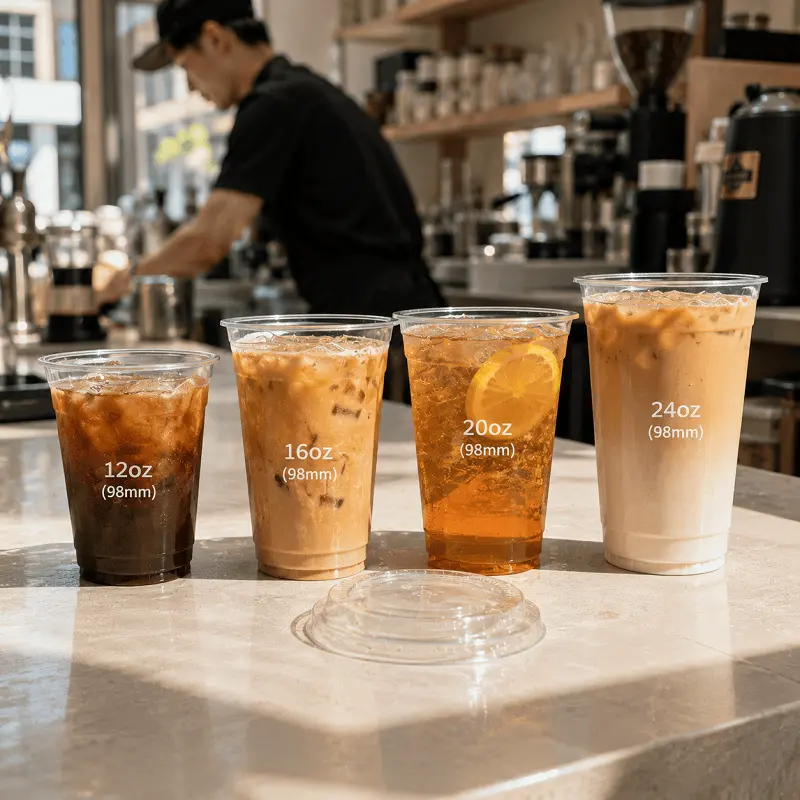
Strategy 1: Embrace "SKU Minimalism" with Universal Beverage Packaging
This is the most immediate and effective way to cut food packaging costs. Many business owners stock a massive variety of disposable cups in different rim sizes and shapes just to differentiate their menu items. This not only clutters your storage room but, more importantly, dilutes your purchasing power. Because your orders are split across many different sizes, you never reach the bulk thresholds required for "volume discounts."
We recommend standardizing your cup rim diameter. At Kayrun, we strongly advise beverage brands to adopt a unified series of 98mm rim diameter PET cups. Whether you are serving a 12oz, 16oz, or 24oz cold drink, they can all share the exact same flat or dome lid.
This approach instantly doubles or triples your lid order volume, enabling you to unlock more competitive factory-direct pricing from your packaging supplier. Furthermore, during peak rush hours, your staff won't waste valuable seconds searching for matching cups and lids. This streamlined in-store workflow represents a significant, hidden cost saving. From a manufacturing perspective, we perform the most frequent maintenance on our 98mm gold-standard molds to ensure a laboratory-grade fit for every single batch.
Strategy 2: Optimize Purchase Frequency to Lower Shipping and Freight Costs
For overseas cafe owners, a massive portion of the packaging unit cost isn't the cup itself—it's the shipping. The ocean freight and local delivery fees per unit are vastly different when ordering 20 cartons versus 100 cartons at a time. We highly encourage business owners to manage their inventory through "quarterly stocking cycles."
Instead of ordering monthly, placing one large order every three months and choosing Full Container Load (FCL) or Less than Container Load (LCL) sea freight can reduce your per-unit packaging costs by over 15%.
To support this model, we offer tailored "Scheduled Releases" or "Price Lock" inventory services. You can pay for your order in advance to lock in favorable raw material pricing, and we will produce and hold the inventory, shipping it to you in planned stages. This effectively helps you bypass seasonal price spikes (such as the summer rush) and keeps your business cash flow highly flexible.

Strategy 3: Leverage Material Science to Reduce Beverage Packaging Waste
Why do some cheap disposable cups feel flimsy and soft in your hand? It's usually because the manufacturer used low-purity raw materials or outdated production machinery. To make these inferior cups rigid enough to hold drinks, small factories are forced to increase the cup's thickness, which ironically increases both their manufacturing cost and their carbon footprint.
At Kayrun, we utilize advanced "uniform stretching" technology in our thermoforming process. By optimizing the molecular alignment of high-purity PET materials, we can reduce the cup's weight (resulting in lower shipping costs) while actually increasing its physical compression strength.
When shop owners receive our cups, they often notice that although our recommended models are lighter in weight, their structural rigidity is exceptional—fully capable of withstanding the rigors of third-party delivery services. Our automated production lines feature inline weighing sensors that check products every 30 minutes, keeping weight deviations under 0.01 grams. Controlling this weight consistency is how we use engineering precision to protect your profit margins.
Strategy 4: Minimize In-Store Defect Rates and Loss
According to industry data, busy cafes and bubble tea shops lose up to 3% of their packaging inventory due to cracked cups, dented rims, or lids that simply won't snap shut. If your store uses 10,000 cup-and-lid sets a month, that is 300 sets going straight into the trash can.
The root cause of this waste is poor mold precision. During our product development phase, we run 1:1 3D structural simulations of our cups and lids, followed by 72-hour constant temperature pressure testing. Additionally, our rolled-rim technology ensures a perfectly uniform cup lip with zero burrs.
This gives your baristas a smooth, satisfying tactile feel during assembly and guarantees a "one-snap secure fit" almost every time. Cutting that 3% in-store loss directly translates into pure, added profit for your bottom line.
Strategy 5: Implement High-Compatibility Custom Packaging from the Source
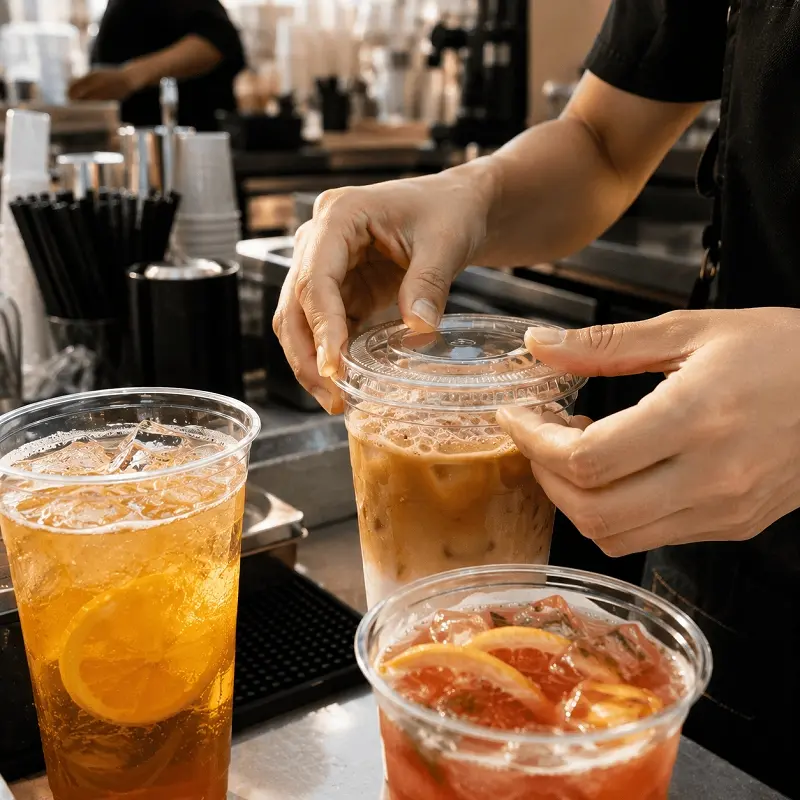
If your business is in the early stages and not yet ready for high-volume custom cup printing, you do not have to settle for plain, unbranded packaging. You can use our high-quality stock clear cups and pair them with custom cup sleeves or branding stickers. This approach allows you to achieve visual differentiation at a fraction of the cost.
Our professional consulting team is always available to analyze local market regulations and consumer trends. For example, in regions like Australia, local governments offer subsidies or tax exemptions for specific eco-friendly, certified compostable materials. We can guide you to choose the exact certified recyclable or biodegradable series that qualifies you for these incentives, drastically reducing your regulatory and policy costs.
As a direct-to-market factory, we don't just sell cups; we act as your business growth consultant. We understand that every penny counts for a growing food and beverage brand. By partnering with a factory that owns a fully integrated quality control chain, you bypass middleman markups and secure globally competitive, premium beverage packaging. As you prepare for the busy summer season, optimizing these details will give your profit margins a resilient edge over your competition.